Lighting is a cornerstone of medical practice, shaping both the efficiency of healthcare professionals and the quality of patient care. It directly affects visual accuracy and procedural precision: insufficient light strains the eyes, accelerates fatigue, and increases the risk of missing critical clinical details.
Yet the lighting needs of different medical zones vary dramatically. What works for a routine checkup is wholly inadequate for an operating room. That’s why understanding the gap between conventional medical lights and surgical lights is essential — and why it matters in realworld practice.

The first major difference lies in light intensity. A moderate level may suffice for an initial patient assessment, but surgery demands far more. Surgical lights deliver illumination many times stronger than standard models — a must when working with tiny anatomical structures where visual fidelity can determine the outcome of an intervention.
Equally important is how light is distributed. Conventional fixtures produce a directed beam that inevitably creates shadows, especially when hands or instruments get in the way. In an operating theatre, those shadows can partially obscure the surgical field. The shadowless effect — achieved through multiple light sources and overlapping beams — ensures stable, continuous visualisation even during active manipulation. This is the hallmark of surgical lighting.

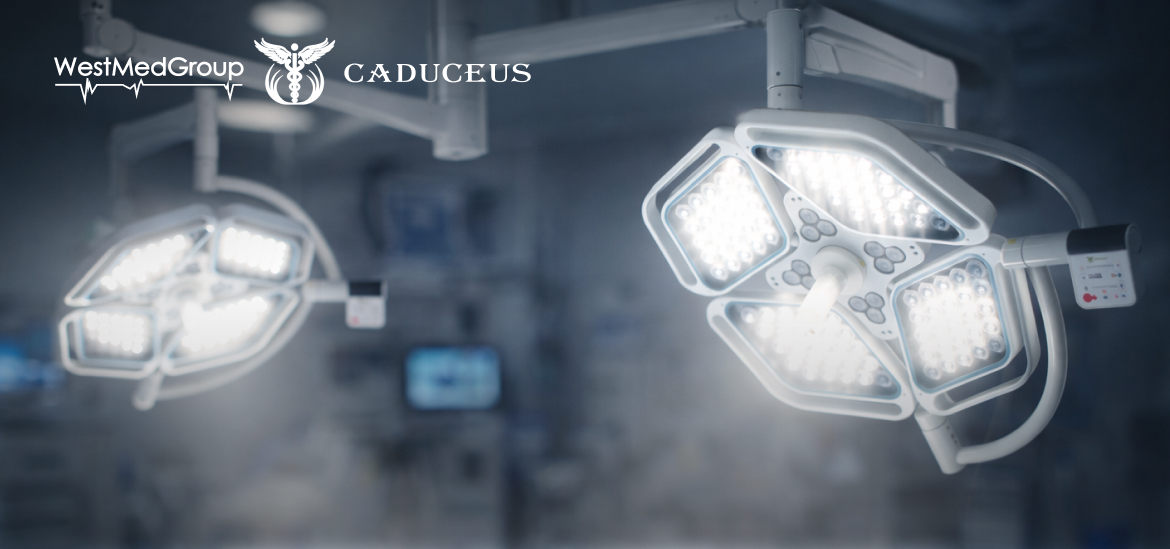
Take the CADUCEUS models as a prime example. Engineered for realworld operating rooms, they offer intuitive controls, simplified adjustment, and secure positioning of light heads. No matter the size of the light field, the preset brightness remains constant, so visual conditions stay predictable throughout the entire procedure. Thanks to LED technology, heat emission is minimised, and maintenance demands drop — a real advantage in daily use.
Design matters, too. The sleek, aerodynamic shape and thoughtful geometry do not disrupt laminar airflow in the operating room, helping preserve sterility. An added bonus: the ability to integrate video systems, enabling recording and live streaming — invaluable for training and remote specialist collaboration.
In short, the difference between conventional and surgical lights is not merely quantitative but qualitative. In the operating room, lighting ceases to be a mere accessory — it becomes a fullfledged surgical instrument, directly affecting the surgeon’s precision, the length of the procedure, and ultimately, the patient’s outcome.